For decades, organizations invested heavily in Training & Development (T&D) to ensure employees had the skills needed to perform their jobs effectively.
Today, however, leading companies are increasingly talking about Learning & Development (L&D) instead.
At first glance, the two terms may seem interchangeable. Both focus on employee growth, skill-building, and performance improvement.
But the difference between L&D and T&D reflects a much larger shift in how organizations think about talent.
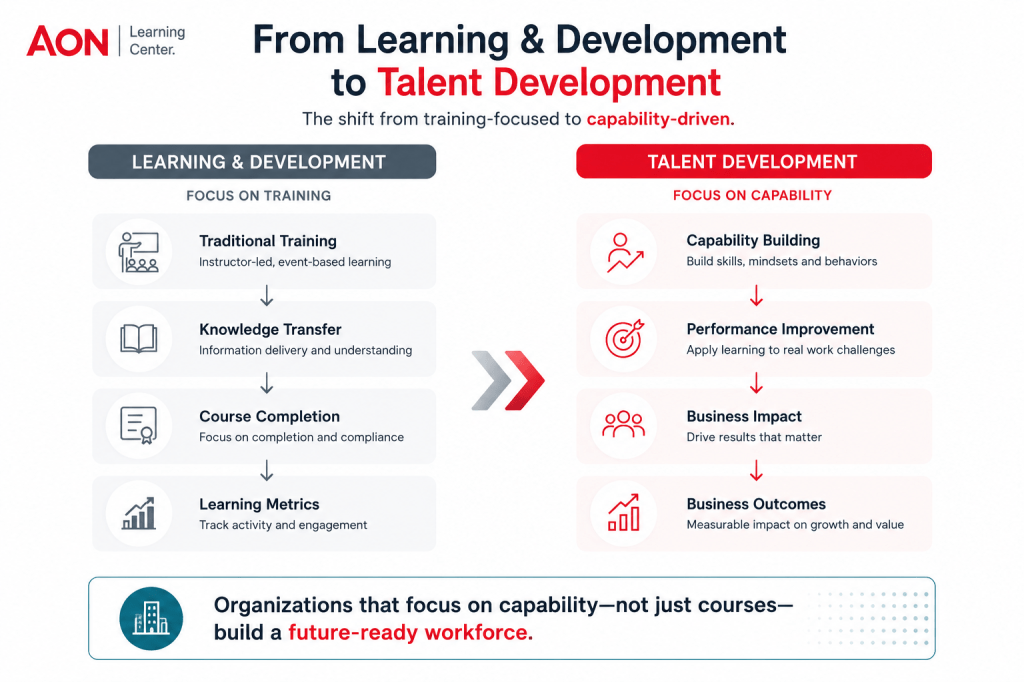
In a business environment shaped by AI, digital transformation, changing workforce expectations, and continuously evolving skill requirements, simply training employees is no longer enough.
Organizations need to continuously develop capabilities, prepare future leaders, and create a culture of ongoing learning.
This is where Learning & Development comes in.
The Evolution from Training to Learning
Traditional Training & Development emerged when jobs were relatively stable.
Organizations identified a skill gap, delivered training, measured knowledge acquisition, and expected employees to apply what they learned.
The model was straightforward:
Need → Training → Performance Improvement
While effective for technical, compliance, and operational skills, this approach was designed for a world where job requirements changed slowly.
Today’s reality is different.
Skills become obsolete faster. Roles evolve constantly. New technologies emerge every year.
As a result, organizations need employees who don’t just learn a skill once—they need employees who continuously learn.
This shift has led many organizations to broaden their focus from T&D to L&D.
What Is Training & Development (T&D)?
Training & Development focuses on improving employee performance in their current role.
The objective is to ensure employees possess the knowledge, skills, and competencies needed to perform specific tasks effectively.
Common examples include:
- Product training
- Compliance training
- Sales training
- Software training
- Customer service programs
- Technical certifications
Training is typically structured, instructor-led, time-bound, and focused on a clearly defined outcome.
The question T&D seeks to answer is:
“What skills does this employee need to perform better today?”
What Is Learning & Development (L&D)?
Learning & Development is a broader strategic function focused on building long-term organizational capability.
Rather than concentrating solely on current job performance, L&D helps individuals grow throughout their careers while preparing the organization for future business needs.
L&D may include:
- Leadership development
- Coaching and mentoring
- Succession planning
- Career pathways
- Digital learning ecosystems
- Internal knowledge sharing
- Workforce upskilling initiatives
- Capability academies
- Experiential learning
The question L&D seeks to answer is:
“What capabilities will our workforce need tomorrow?”
This subtle shift in thinking fundamentally changes how organizations approach employee development.
The Real Difference: Skills vs Capability
The simplest way to understand the distinction is this:
T&D Builds Skills
Training helps employees learn how to perform a task.
For example:
- A recruiter learns structured interviewing.
- A manager learns performance review techniques.
- A salesperson learns a new CRM platform.
The outcome is immediate skill improvement.
L&D Builds Capability
Learning helps employees develop the mindset, adaptability, judgment, and leadership required to succeed in increasingly complex environments.
For example:
- Future leaders learn strategic thinking.
- HR professionals develop business partnering capabilities.
- Managers strengthen coaching and change leadership skills.
The outcome is long-term organizational capability.
Why L&D Has Become a Strategic Priority
Organizations are no longer competing purely on products, technology, or capital.
They are increasingly competing on talent.
According to multiple workforce studies, many organizations cite skill shortages, leadership readiness, and workforce transformation as critical business challenges.
As a result, CEOs are asking different questions:
- Do we have future-ready leaders?
- Are our employees prepared for AI-enabled work?
- Can we fill critical roles internally?
- How quickly can we develop new capabilities?
These questions cannot be solved through training alone.
They require a broader Learning & Development strategy.
Does This Mean T&D Is Obsolete?
Not at all.
In fact, effective Learning & Development strategies rely heavily on strong training foundations.
Organizations still need:
- Onboarding programs
- Functional skill development
- Compliance training
- Technical certifications
- Process and systems training
Training remains one of the most effective methods for developing specific skills.
The difference is that modern organizations no longer view training as the end goal.
It is one component of a larger learning ecosystem.
What High-Performing Organizations Do Differently
Leading organizations combine both approaches.
They use Training & Development to solve current capability gaps and Learning & Development to prepare for future business challenges.
For example:
| Business Need | T&D Approach | L&D Approach |
|---|---|---|
| New managers | Management training program | Multi-year leadership journey with coaching |
| HR transformation | HR systems training | Strategic HR capability development |
| Digital adoption | Platform training | Digital mindset and future-skills development |
| Talent retention | Role-based training | Career growth and learning pathways |
This integrated approach creates a workforce that is both productive today and prepared for tomorrow.
For HR Leaders: Should Your Function Be Called L&D or T&D?
The answer depends on your mandate.
If your primary focus is delivering training programs, certifications, workshops, and compliance requirements, T&D may accurately reflect your scope.
If your objective includes leadership development, workforce capabilities, succession planning, culture building, and future skills, L&D is a more accurate representation.
This is why many organizations have rebranded traditional training departments into Learning & Development functions over the past decade.
The name change reflects a broader shift in responsibility—from delivering courses to enabling organizational growth.
Building a Future-Ready Workforce
The most successful organizations recognize that learning is no longer an event.
It is an ongoing business capability.
Employees need opportunities to continually develop new skills, adapt to change, and prepare for future opportunities.
Organizations that invest in both effective training and long-term learning are often better positioned to attract talent, retain high performers, drive innovation, and navigate workforce transformation.
How Organizations Can Move from T&D to Strategic L&D
Many organizations recognize the value of Learning & Development but struggle to translate that vision into practice. Delivering training programs is relatively straightforward. Building a learning function that drives business outcomes is significantly more complex.
A mature L&D strategy goes beyond courses and workshops. It requires organizations to identify critical future skills, create capability frameworks, build leadership pipelines, establish career development pathways, and measure the impact of learning on business performance.
For example, if an organization is preparing for digital transformation, AI adoption, rapid growth, or leadership succession, traditional training alone may not be enough. Employees need ongoing opportunities to build new capabilities, apply learning in real-world situations, collaborate across functions, and develop the adaptability required in a changing business environment.
This is why leading organizations are increasingly shifting their focus from training delivery to capability building. Rather than asking, “What training should we offer?”, they ask, “What capabilities will our business need to succeed over the next three to five years?”
Answering that question often requires a more tailored approach than off-the-shelf training programs can provide. Learning initiatives must align with business strategy, organizational culture, workforce challenges, and long-term talent objectives.
Organizations looking to design customized learning journeys, leadership development initiatives, capability academies, or workforce transformation programs can explore Aon’s Bespoke Learning & Corporate Training Solutions. These solutions are designed around specific business objectives and can help organizations build the skills and capabilities needed for sustainable growth.
Ultimately, the transition from T&D to strategic L&D is not about replacing training. It’s about ensuring that learning becomes a driver of organizational performance, innovation, and future readiness.





Leave a Reply