

Recruitment has always been about finding the right person for the right role. What has changed is how much technology now sits between a job description and the final hiring decision.
Applicant Tracking Systems (ATS) have become a core part of recruitment workflows, helping organizations manage applications, organize candidate information and move applicants through different stages of the hiring process. Now, artificial intelligence is taking that automation further — helping recruiters source candidates, screen applications, draft job descriptions, communicate with applicants and identify potential matches.
For recruiters and Talent Acquisition professionals, the challenge isn’t simply learning how to use these technologies. It is understanding how ATS and AI influence hiring decisions, where they add value, and where human judgment still needs to take the lead.
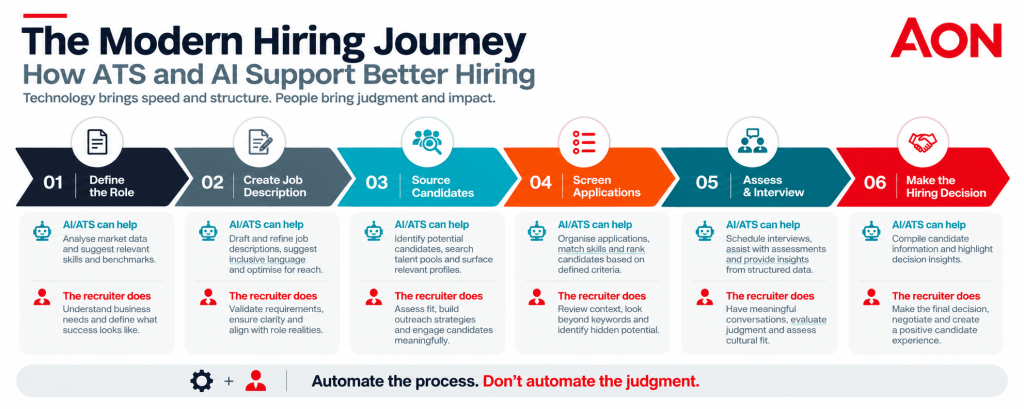
What Is an ATS and Why Does It Matter?
An Applicant Tracking System is software designed to help employers manage the recruitment process.
Instead of keeping applications across emails, spreadsheets and separate folders, an ATS gives recruiters a central system for managing candidates and recruitment activity.
Depending on the platform, an ATS can help with:
- Posting vacancies across job boards and career sites
- Collecting and organising applications
- Searching candidate profiles and resumes
- Filtering candidates against defined criteria
- Tracking candidates through the recruitment pipeline
- Scheduling interviews
- Managing recruiter and hiring-manager collaboration
- Maintaining candidate records
- Reporting on recruitment activity
For recruiters working on high-volume roles, this can make a significant difference. Reviewing hundreds or thousands of applications manually isn’t simply time-consuming — it also makes it harder to maintain a consistent process.
ATS technology provides the structure. AI is increasingly providing another layer of intelligence on top of that structure.
How AI Is Changing the Hiring Process
AI in recruitment isn’t one single technology. It can appear at several different stages of the hiring journey.
1. Writing and refining job descriptions
Generative AI can help recruiters create job descriptions, improve clarity and tailor recruitment content to different audiences.
This can save time, particularly when recruiters are managing multiple requisitions.
But there is an important distinction between generating a job description and creating a good job description.
Recruiters still need to check whether the requirements are genuinely necessary, whether the language is inclusive, and whether the description accurately reflects the role.
A well-written job description should help identify the capabilities that matter — not simply produce a longer list of qualifications.
2. Sourcing candidates
AI can help recruiters identify potential candidates based on skills, experience and other relevant information.
Instead of relying entirely on manual searches, recruiters can use technology to narrow a large talent pool and identify people who may be worth approaching.
This is particularly useful when hiring for specialised or hard-to-fill positions.
The recruiter’s role, however, doesn’t disappear. AI can identify a potential match; the recruiter needs to determine whether that person actually makes sense for the role.
3. Resume screening
This is one of the areas where ATS and AI are often discussed together.
An ATS can organise applications and make candidate information searchable. AI can go further by helping identify patterns, skills or experiences that may correspond to the requirements of a position.
That can make the initial screening process faster.
But recruiters should be careful about treating an automated ranking as a final answer.
A candidate’s suitability cannot always be reduced to a list of keywords.
For example, someone may have developed a relevant skill through a different job title, industry or career path. A rigid screening process could miss that candidate even though their underlying capabilities are highly relevant.
Technology should help recruiters find candidates — not prevent them from seeing them.
ATS + AI Doesn’t Mean “Human-Free” Hiring
One of the biggest misconceptions about AI in recruitment is that the goal is to remove people from the process.
In reality, the more useful question is:
Which parts of recruitment should technology handle, and which parts require human judgment?
AI is particularly useful for repetitive, high-volume tasks:
| Recruitment activity | Where technology can help | Where humans matter |
| Job descriptions | Drafting and refining content | Defining what the role actually requires |
| Sourcing | Finding potential matches | Assessing whether candidates genuinely fit |
| Resume screening | Identifying relevant skills and experience | Understanding context and non-linear careers |
| Candidate communication | Drafting routine messages | Building relationships and trust |
| Interview scheduling | Automating coordination | Conducting meaningful conversations |
| Candidate assessment | Organising information and identifying patterns | Evaluating judgment, communication and potential |
| Recruitment analytics | Identifying trends | Deciding what action to take |
The most effective approach is therefore not AI versus recruiters.
It is AI + recruiter.
Recent research and industry guidance increasingly point toward this combination: AI can take on repetitive work while recruiters spend more time on activities requiring context, judgment and human interaction.
The ATS Doesn’t Know Everything About a Candidate
There is another important point recruiters need to understand.
An ATS works with the information it receives.
If a resume doesn’t clearly communicate a relevant skill, the system may not recognise its importance. If a job description contains unnecessary requirements, the screening process can become unnecessarily restrictive. And if the underlying data or criteria are flawed, automation can potentially scale those flaws across a much larger candidate pool.
AI can identify patterns extremely quickly. That doesn’t automatically make those patterns meaningful.
This is why recruiters need to understand what the technology is actually evaluating.
A strong Talent Acquisition professional shouldn’t simply ask:
“What did the system rank this candidate?”
They should also ask:
“Why did the system rank this candidate this way — and does that reasoning make sense for the role?”
That distinction becomes increasingly important as AI becomes more deeply integrated into recruitment workflows.
Candidate Experience Matters More in an Automated Process
Automation can make recruitment faster, but speed isn’t the only measure of a good hiring process.
Candidates still want clarity, communication and a sense that there is a real organisation — and real people — behind the process.
Consider the difference between:
“Application received. Status: Under Review.”
and
“Thanks for applying. Your application has been received and is currently being reviewed. We’ll update you when there is a change in your application status.”
Both messages can be automated. The second one feels considerably more human.
As AI becomes more common on both sides of recruitment, this matters even more. Candidates are increasingly using AI to tailor resumes, applications and other job-search materials, while employers are using AI to improve sourcing, screening and communication.
Recruiters therefore need to think beyond automation and consider the experience created by automation.
Five Things Recruiters Should Do When Working with ATS and AI
1. Start with the role, not the technology
Before using an AI tool or screening system, be clear about what success in the role actually looks like.
Identify the essential skills, experience and behaviours first.
Technology should support that framework — not create it.
2. Understand the screening criteria
Recruiters should know what their ATS or AI-enabled recruitment tools are looking for.
If the system is filtering candidates, understand the criteria behind the filtering.
If candidates are being ranked or recommended, understand which signals are influencing those recommendations.
3. Don’t confuse keywords with capability
A keyword appearing on a resume doesn’t necessarily mean the candidate has the required capability.
Likewise, the absence of a particular phrase doesn’t necessarily mean the candidate lacks the skill.
Look beyond terminology and consider context.
4. Keep human review where it adds value
Automation is most useful when it reduces repetitive work.
Use the time saved to have better conversations with candidates, understand hiring-manager needs and evaluate the factors technology cannot reliably capture.
5. Keep improving your own AI literacy
Recruitment technology is evolving quickly. New AI capabilities are being added to hiring platforms, while candidates are also becoming more sophisticated in how they use AI during their job search.
Recruiters therefore need more than basic familiarity with an ATS.
They need to understand how technology changes the way Talent Acquisition works.
The Recruiter of the Future Is Both Tech-Savvy and People-Savvy
The rise of AI doesn’t make recruitment less human.
In many ways, it makes human skills more valuable.
When technology takes care of repetitive tasks, recruiters have more opportunity to focus on the parts of Talent Acquisition where experience and judgment make a difference: understanding people, challenging assumptions, advising hiring managers, assessing candidates and building trust.
The strongest recruiters won’t necessarily be the ones who use the most AI.
They’ll be the ones who understand when to use it, how to use it and when not to rely on it.
That requires a combination of recruitment fundamentals, technology awareness and practical Talent Acquisition skills.
For professionals looking to build those capabilities, the Certified Talent Acquisition Ready program is designed to help develop the skills needed to navigate modern Talent Acquisition and recruitment.
Final Takeaway
ATS and AI are changing hiring, but technology doesn’t replace the fundamentals of good recruitment.
A strong hiring process still starts with understanding the role, identifying the right capabilities and making thoughtful decisions about people.
The difference is that recruiters now have technology that can help them do much of the operational work faster. The opportunity is to use that technology wisely — automate the repetitive, analyse the information, and keep human judgment at the centre of the decisions that matter.


Leave a comment