

Learning and Development (L&D) has changed significantly over the past few years.
For a long time, employee training was often treated as a support function: identify a training need, schedule a program, track attendance and move on.
That approach is becoming less effective.
Organizations today are dealing with changing technologies, evolving job roles, new skill requirements and employees who expect opportunities to grow. As a result, L&D is increasingly becoming a strategic part of how organizations build and retain talent.
The challenge is no longer simply providing training.
It is about making sure people develop the right capabilities, at the right time, in ways that support both their careers and the organization’s goals.
What Is an L&D Strategy?
An L&D strategy is a structured approach to helping employees develop the knowledge, skills and capabilities they need to perform effectively today and prepare for what comes next.
A strong strategy connects three things:
Business needs + Employee aspirations + Future skills
This means L&D teams need to understand more than what courses are available. They need to understand where the organization is going, what capabilities it will need and how employees can develop those capabilities.
For example, if an organization is introducing new technology across its operations, simply providing a generic technology training course may not be enough.
The L&D team needs to consider:
- Which roles will be affected?
- What skills will employees need?
- Which employees need foundational training?
- Which employees need advanced capabilities?
- How will managers support the transition?
- How will learning be applied on the job?
- How will the organization know whether the investment worked?
That is the difference between training delivery and strategic L&D.
Why L&D Is Becoming a Business Priority
Skills don’t remain static.
Technology changes, customer expectations evolve and organizations restructure the way work gets done. Roles that exist today may require very different capabilities in the future.
This creates a continuous need for organizations to develop their workforce.
A strong L&D function can contribute to several important business priorities.
Building critical skills
Organizations can develop capabilities internally instead of relying entirely on external hiring.
Supporting employee retention
Employees who see opportunities to learn and progress may have stronger reasons to build their careers within the organization.
Improving performance
Relevant learning can help employees perform their current roles more effectively.
Preparing for change
L&D can help employees adapt when organizations introduce new technology, processes or ways of working.
Developing future leaders
Leadership development can create a stronger pipeline of talent for future roles.
The common thread is simple:
L&D creates value when learning is connected to something the organization is trying to achieve.
Start With the Business Problem, Not the Training Course
One of the easiest mistakes in L&D is starting with the question:
“What training should we provide?”
A better starting point is:
“What business or performance problem are we trying to solve?”
Consider a sales organization where conversion rates have fallen.
The answer might be a sales training program — but it might also be a problem with the sales process, technology, incentives, management practices or customer demand.
If the underlying issue isn’t a lack of capability, training alone won’t solve it.
This is why effective L&D professionals need strong performance consulting and needs analysis skills.
Before recommending learning, they should understand:
- What is happening today?
- What should be happening?
- What is causing the gap?
- Is the gap related to knowledge or skills?
- Can learning realistically address it?
- What should change after the learning?
Only then should the learning solution be designed.
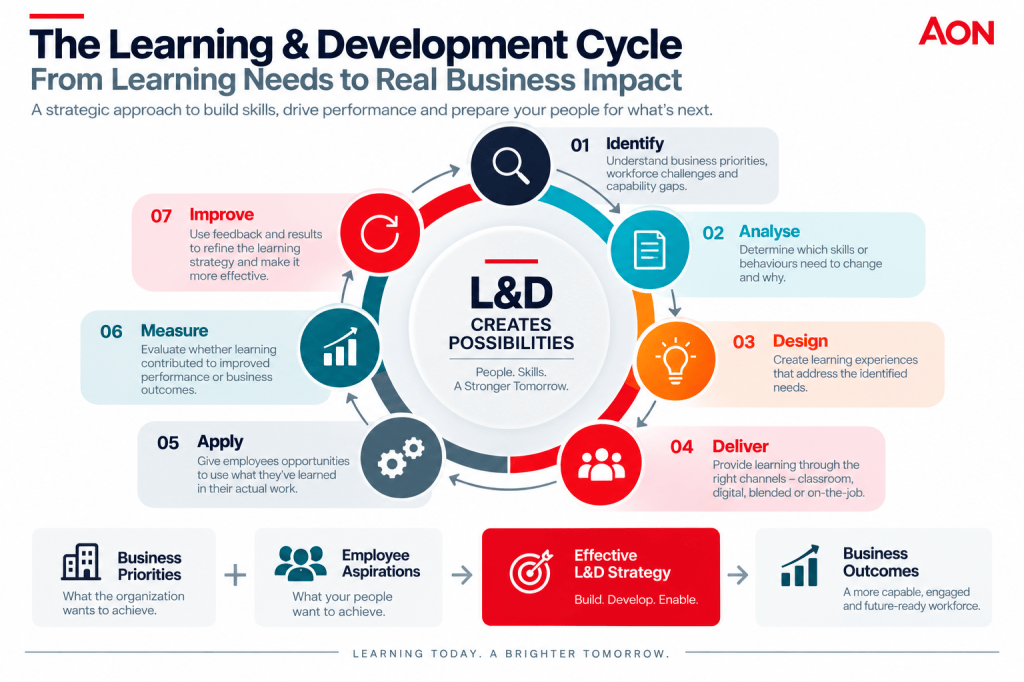
The L&D Cycle: From Need to Impact
A practical L&D strategy can be viewed as a continuous cycle.
1. Identify
Understand business priorities, workforce challenges and capability gaps.
2. Analyse
Determine which skills or behaviours need to change and why.
3. Design
Create learning experiences that address the identified needs.
4. Deliver
Provide learning through the channels that make sense for the audience.
5. Apply
Give employees opportunities to use what they have learned in their actual work.
6. Measure
Evaluate whether learning contributed to improved performance or business outcomes.
7. Improve
Use feedback and results to refine the learning strategy.
The important part is that the cycle doesn’t end when a course is completed.
Completion is an activity. Application and impact are the outcomes.
Not Every Learning Need Requires a Course
Another important consideration for L&D teams is that training isn’t always the answer.
Sometimes an employee doesn’t know how to perform a task.
That’s a potential learning problem.
But sometimes the employee knows exactly what to do and simply doesn’t have the right tools, resources, incentives or support.
That’s a different problem.
For example, if employees are struggling to complete a process because the internal system is difficult to use, another training session may not fix the issue.
L&D professionals should therefore consider a broader range of solutions:
- Coaching
- Mentoring
- Job aids
- Knowledge resources
- Peer learning
- Manager support
- Communities of practice
- On-the-job experiences
- Formal training
- Digital learning
The best solution is the one that addresses the actual performance need.
Designing Learning That Employees Will Actually Use
Even a well-designed program can fail if it doesn’t fit into the employee’s working environment.
Employees have competing priorities. Learning therefore needs to be relevant, accessible and practical.
Effective learning experiences often include a combination of:
Relevant content
Employees should understand why the learning matters to their role.
Practical application
People should have opportunities to practise rather than simply consume information.
Reinforcement
A single learning event rarely creates lasting behaviour change. Follow-up activities, coaching, reminders and practical application can help reinforce new skills.
Manager involvement
Managers can play an important role by creating opportunities for employees to apply what they’ve learned.
Flexibility
Different employees may prefer different learning formats, including workshops, digital learning, coaching, peer learning or self-directed resources.
The goal isn’t to choose the trendiest learning format.
It’s to create a learning experience that helps people change what they know, do or demonstrate.
The Role of Technology in Modern L&D
Technology has expanded the options available to L&D teams.
Learning platforms can provide employees with access to content when they need it. Data and analytics can help L&D teams understand participation and learning activity. AI can also support areas such as content creation, personalization, skills analysis and learning recommendations.
But technology should support the learning strategy rather than become the strategy itself.
A sophisticated learning platform doesn’t automatically create a strong learning culture.
The more important questions remain:
- What skills do employees need?
- What learning experience will help develop them?
- How will employees apply those skills?
- What support will they receive?
- How will we measure the impact?
Technology is an enabler.
The strategy comes first.
Moving From Courses to Skills
One of the biggest shifts happening in L&D is a move toward thinking in terms of skills rather than courses.
A course is a learning intervention.
A skill is a capability that an employee can actually use.
For example, an organization might offer a course on leadership fundamentals. But the real objective could be to help managers:
- Give better feedback
- Delegate effectively
- Handle difficult conversations
- Coach team members
- Make better decisions
The course itself isn’t the final goal.
The desired capability is.
This shift helps L&D teams think more clearly about the connection between learning and performance.
Instead of asking:
“How many people completed the leadership program?”
they can also ask:
“Are managers demonstrating the leadership behaviours we were trying to develop?”
That’s a much more meaningful measure of learning impact.
Measuring L&D Beyond Completion Rates
Completion rates are easy to measure.
They are also only one part of the picture.
A more useful L&D measurement approach considers multiple levels.
Participation
Did employees engage with the learning?
Learning
Did they develop the intended knowledge or skills?
Application
Are they using those skills in their work?
Performance
Has individual or team performance improved?
Business impact
Has the learning contributed to a meaningful organizational outcome?
The specific metrics will depend on the learning objective.
For example, a customer-service program might look at customer satisfaction or resolution rates, while a leadership program could examine manager effectiveness, employee engagement or internal mobility.
The key is to decide what success looks like before the learning begins.
Building a Strong Learning Culture
L&D cannot create a learning culture on its own.
Employees need to feel that learning is supported by the organization and their managers.
A strong learning culture can involve:
- Managers encouraging development conversations
- Employees having access to relevant learning opportunities
- Recognition for skill development
- Opportunities to apply new capabilities
- Internal mobility and career pathways
- Knowledge sharing between colleagues
- Time and space for development
This changes the perception of learning.
Instead of being something employees are occasionally sent to do, learning becomes part of how work and career development happen.
What Does the Future L&D Professional Need?
The L&D profession itself is evolving.
Modern L&D professionals need to be comfortable moving between different areas of the organization.
They may need to understand:
- Learning needs analysis
- Instructional design
- Adult learning principles
- Facilitation
- Digital learning
- Talent and skills strategy
- Learning technology
- Learning analytics
- Stakeholder management
- Business alignment
- Measuring learning impact
Perhaps most importantly, they need to understand the business context behind the learning request.
An L&D professional who can connect a capability gap to a business outcome can have a much greater strategic impact than someone focused only on delivering training programs.
The Future of L&D Is About Capability, Not Just Training
The organizations that get the most from L&D won’t necessarily be those that offer the largest number of courses.
They will be the organizations that understand which capabilities matter, create effective ways for employees to develop those capabilities and give people opportunities to apply them.
That requires L&D professionals to think beyond the training room.
Learning should lead somewhere.
It should help someone perform better, prepare for a new role, develop a critical skill, adapt to change or contribute to a business priority.
For professionals looking to build the knowledge and capabilities required to work effectively in modern Learning & Development, the Certified Learning & Development Professional from Aon Learning Center offers a relevant pathway to develop those skills.
Final Takeaway
A successful L&D strategy isn’t measured by how many courses an organization delivers.
It is measured by whether learning helps people and the organization move forward.
The strongest L&D teams start with business and performance needs, identify the capabilities required, design learning around those needs, support employees in applying what they learn and measure the resulting impact.
In a workplace where skills and roles continue to evolve, that makes L&D more than a training function.
It makes L&D a key part of building the workforce an organization needs for the future.




Leave a comment