

For years, compensation was often treated as the centre of an organization’s approach to rewarding employees. Salary, bonuses and annual increases were the primary tools used to attract and retain talent.
Today, that approach is no longer enough.
Employees evaluate their overall employment experience — from pay and benefits to career growth, flexibility, recognition and wellbeing. This broader approach is known as Total Rewards.
A well-designed Total Rewards strategy helps organizations answer an important question:
What can we offer employees — beyond salary — that makes them want to join, perform, grow and stay?
The answer will look different for every organization. The key is building a rewards strategy that aligns employee needs with business priorities.
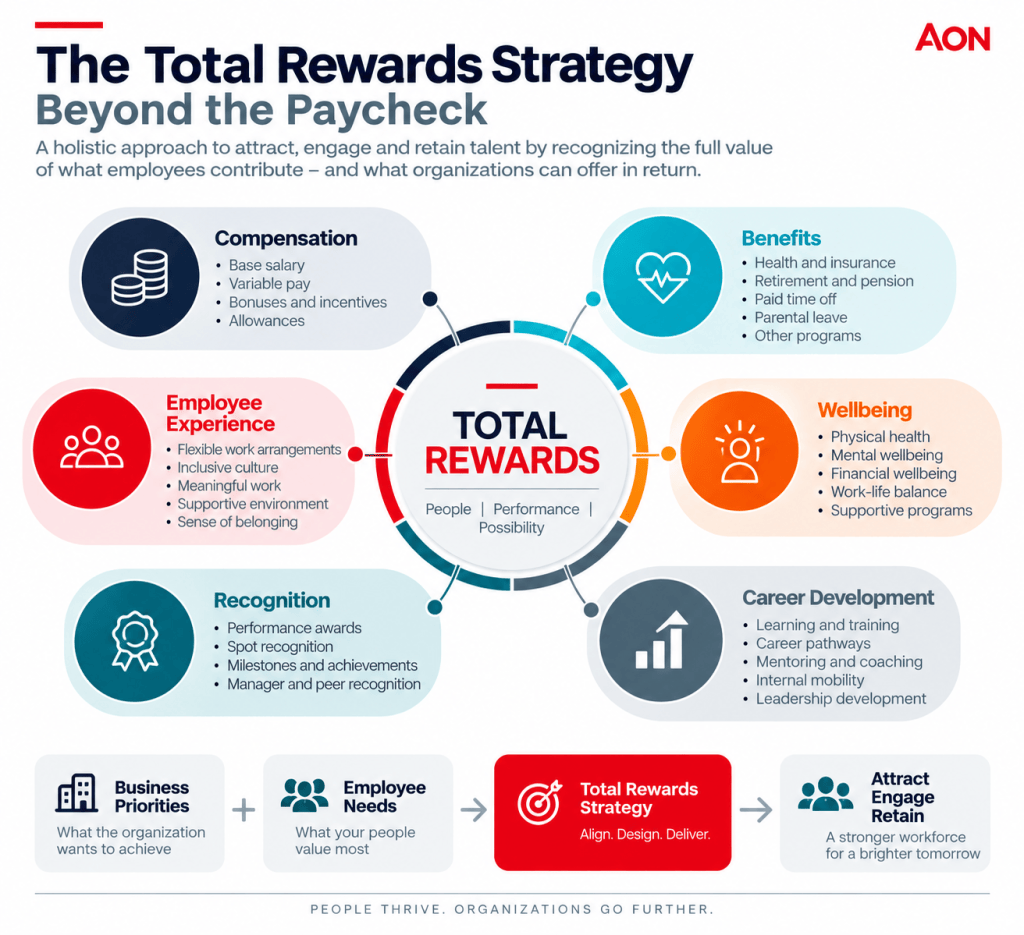
What Is a Total Rewards Strategy?
A Total Rewards strategy is a structured approach to everything an organization provides employees in exchange for their contribution.
It goes beyond compensation and benefits to include the broader factors that influence how employees experience their workplace.
A Total Rewards framework typically includes areas such as:
- Compensation — base pay, variable pay, bonuses and incentives
- Benefits — health, retirement, insurance, leave and other programs
- Wellbeing — physical, financial, mental and social wellbeing initiatives
- Career development — learning, skills development, career paths and opportunities
- Recognition — formal and informal ways of acknowledging contributions
- Work environment — flexibility, workplace culture and employee experience
The important point is that these elements shouldn’t operate independently.
A strong Total Rewards strategy considers how they work together to support the organization’s talent strategy.
Why Total Rewards Matters More Than Ever
The expectations employees have from their employers continue to evolve.
Two employees with identical salaries may have very different perceptions of the value they receive from their employers.
One might prioritize flexible working arrangements. Another may place greater importance on healthcare benefits, career progression or additional learning opportunities.
This creates a challenge for organizations:
How do you design a rewards offering that is valuable to different employees while remaining sustainable for the business?
A Total Rewards approach provides a framework for thinking about that question.
Rather than asking only, “Are we paying competitively?”, organizations can consider the complete employee value proposition.
The Five Key Elements of Total Rewards
While organizations may structure their frameworks differently, there are several core areas that commonly form part of a Total Rewards strategy.
1. Compensation
Compensation remains a fundamental component.
Employees need to feel that their pay appropriately reflects their role, skills, contribution and the market in which they operate.
Compensation can include:
- Base salary
- Variable compensation
- Short-term incentives
- Long-term incentives
- Sales incentives
- Performance-related pay
- Allowances
However, simply increasing salaries isn’t always the most effective way to address reward challenges.
Organizations also need to consider pay structures, internal equity, external competitiveness and how compensation supports business objectives.
A well-designed compensation approach should be both competitive and sustainable.
2. Benefits
Benefits can significantly influence an employee’s perception of their overall rewards package.
Depending on the organization and workforce, these may include:
- Health insurance
- Retirement and pension benefits
- Paid time off
- Parental leave
- Life and disability insurance
- Financial wellbeing programs
- Employee assistance programs
The challenge isn’t simply offering more benefits.
It’s offering benefits that employees actually value.
For example, a benefit that is highly valued by one workforce may have considerably less impact for another.
This is why understanding employee needs is an important part of Total Rewards design.
3. Wellbeing
Employee wellbeing has become an increasingly visible part of the rewards conversation.
Organizations may support employees through programs addressing:
- Physical health
- Mental wellbeing
- Financial wellbeing
- Work-life balance
- Workplace flexibility
But wellbeing shouldn’t be viewed as a collection of isolated perks.
A free fitness membership, for example, won’t compensate for excessive workloads or an unsustainable working environment.
The strongest Total Rewards strategies consider wellbeing alongside the broader employee experience.
4. Career Development
Not every employee is motivated primarily by financial rewards.
For many professionals, opportunities to learn new skills, take on greater responsibility and progress in their careers can be equally important.
Career development can include:
- Training and professional development
- Mentoring
- Coaching
- Internal mobility
- Career pathways
- Leadership development
- Stretch assignments
- Skills-based development
This is particularly important because organizations aren’t simply competing for talent at the point of hiring.
They are also competing to keep talented people engaged and growing once they join.
A strong development offering can therefore support both employee engagement and long-term talent retention.
5. Recognition and Employee Experience
Recognition is another important component of Total Rewards.
Employees want to know that their work is noticed and valued.
Recognition can take many forms:
- Manager recognition
- Peer recognition
- Performance awards
- Spot recognition
- Milestone celebrations
- Career achievements
Importantly, recognition doesn’t always have to be financial.
A meaningful acknowledgement from a manager, greater responsibility or an opportunity to work on an important project can also reinforce an employee’s sense of contribution.
This is where Total Rewards connects closely with organizational culture.
Total Rewards Is More Than a List of Benefits
One common mistake is treating Total Rewards as a catalogue of everything an organization provides.
The strategy is more important than the list.
Imagine an organization offers competitive salaries, excellent healthcare benefits and generous paid leave — but employees have limited opportunities to develop their careers.
Another organization may have a slightly less competitive benefits package but offer strong career development, flexibility and recognition.
Different employees may value these packages differently.
That’s why Total Rewards should start with employee and business needs, rather than simply copying what other organizations offer.
How to Build a Total Rewards Strategy
Building an effective strategy requires more than deciding which benefits to introduce.
Step 1: Understand the business strategy
Start by understanding what the organization is trying to achieve.
Is the business focused on:
- Rapid growth?
- Cost efficiency?
- Innovation?
- Expanding into new markets?
- Building critical skills?
- Improving retention?
The Total Rewards strategy should support these priorities.
For example, an organization trying to build scarce technical capabilities may need to think carefully about market-competitive compensation, skill-based rewards and career development.
Step 2: Understand your workforce
Employee needs aren’t uniform.
Different groups may value different elements of the rewards offering depending on factors such as career stage, role, location and personal priorities.
Organizations can use:
- Employee surveys
- Focus groups
- Engagement data
- Exit interviews
- Workforce analytics
- Market research
to better understand what employees value.
The goal isn’t to create a different rewards package for every individual.
It’s to identify meaningful patterns and make informed decisions.
Step 3: Benchmark the market
External competitiveness matters.
Organizations should understand how their compensation and benefits compare with relevant talent markets.
But benchmarking shouldn’t mean automatically matching the highest number available.
The more useful question is:
What level of competitiveness do we need for the talent we are trying to attract and retain?
Different roles may require different approaches.
Step 4: Evaluate internal equity
External competitiveness is only one side of the equation.
Organizations also need to consider internal consistency.
Employees may question their rewards when they perceive significant unexplained differences between people performing comparable work.
This makes factors such as job architecture, pay structures, role evaluation and consistent reward principles important components of Total Rewards.
Step 5: Design the overall rewards mix
Once employee needs, business priorities and market information are understood, organizations can determine the appropriate mix of rewards.
The objective isn’t necessarily to maximize every component.
Instead, organizations should ask:
Where will our investment create the greatest value for employees and the business?
That could mean strengthening career development rather than adding another benefit, improving recognition practices rather than increasing across-the-board rewards, or redesigning incentive structures to better support business objectives.
Step 6: Communicate the value
Even a well-designed Total Rewards strategy can underperform if employees don’t understand what they receive.
Employees may underestimate the value of benefits simply because they aren’t familiar with them.
Clear communication can help employees understand their total value proposition, rather than focusing only on their monthly salary.
Organizations can communicate rewards through:
- Total Rewards statements
- Employee portals
- Benefits guides
- Manager conversations
- Annual reward communications
- Personalized communications
The message should be simple:
Help employees understand the full value of what the organization provides.
A Total Rewards Strategy Should Be Measurable
A strategy shouldn’t end once the rewards package is launched.
Organizations should evaluate whether it is actually achieving its objectives.
Depending on the organization’s priorities, useful measures might include:
- Employee retention
- Voluntary turnover
- Employee engagement
- Offer acceptance rates
- Time to fill
- Internal mobility
- Participation in benefits
- Learning and development participation
- Pay competitiveness
- Employee perceptions of rewards
The right metrics depend on the organization’s goals.
For example, if the primary objective is improving retention in critical roles, turnover and retention among those populations may be more meaningful than simply measuring overall employee satisfaction.
The Future of Total Rewards Is More Strategic
Total Rewards is moving beyond the traditional question of “What do we pay employees?”
The more strategic question is:
“What combination of rewards and employee experiences will help us achieve our talent and business objectives?”
That requires professionals working in compensation and rewards to understand more than individual reward programs.
They need to be able to connect:
Business strategy → Talent strategy → Employee needs → Rewards strategy → Business outcomes
This is what turns Total Rewards from an HR program into a strategic capability.
Final Takeaway
A competitive salary is important, but it is only one part of the employee value proposition.
A thoughtful Total Rewards strategy brings compensation, benefits, wellbeing, career development, recognition and the broader employee experience together in a way that supports both employees and the organization.
The most effective strategies aren’t necessarily the ones that offer the most.
They’re the ones that understand what matters to their workforce, align rewards with business priorities and communicate that value clearly.
For professionals looking to strengthen their understanding of modern rewards practices and build practical capabilities in this area, the Certified Rewards Ready from Aon Learning Center provides a relevant next step. Because the future of rewards isn’t just about paying people well — it’s about creating a rewards experience that helps people and organizations thrive.




Leave a Reply